Blog Posts

Seal of Approval

The skeleton of your future home now sits outside, waiting for you. Luckily, after all your hard work, it’s time for a breather. The next steps, though slightly tedious, are much easier than the last few steps, as far as skill and decision-making go. By the end of this chapter in your personal tiny house building adventure, you will have a fully sealed, self-supporting structure, and though it might not be an ideal living space yet, you’ll be able to confidently say that, with your own two hands, you put a roof over your head, which was a big moment for me.

We start off by adding extra support to the tiny house with metal banding and fasteners for the hurricane rods (if your trailer has hurricane rods).
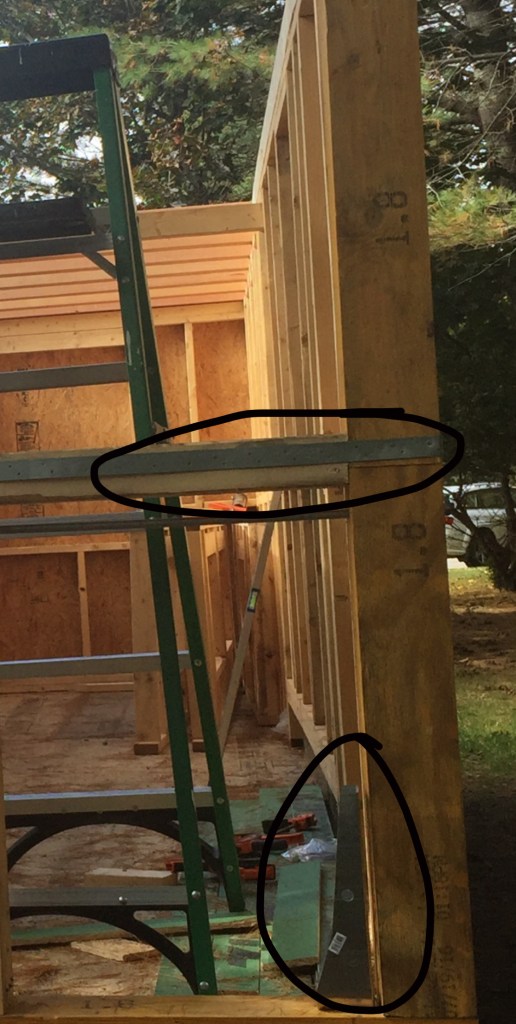
Though it’s hard to tell in this picture, the metal banding has hundreds of nails in it, all of which have to be hand nailed. Because the holes in the banding are quite small, using a nail gun would be extremely difficult and could also result in serious injury if a nail missed the hole and ricocheted off the metal back at you. The hurricane rod fasteners are relatively simple to install. 

It’s mostly a simple matter of nuts, bolts, and screws. However, if you wait to put them on until the sheathing is on like I did, you may run into issues getting the right angle on the screws with your drill as they’re in the corners of your house so the walls can get in the way.

Next up is your sheathing. Most of this process should be relatively easy but there’s still a couple things to keep in mind. You’ll cut out your windows later, so you can use big pieces of plywood to cover all the walls swiftly and without much issue. You may want a friend to help you, though, as big pieces of plywood are not only heavy, but lining them up correctly, finding your studs to nail them into, and holding them in place while nailing them on, is next to impossible alone. You also need to remember that before you put your sheathing on, you need to put liquid nail construction adhesive on all the studs to help keep everything together while you’re going on the road.  

Another thing to plan for, before you start throwing pieces of sheathing on your house, is how big your sheathing boards are relative to the surface area of your walls. You want to do your best to have similarly sized pieces across your wall and to avoid having random slivers on the ends, you also want to stagger the boards so there are no continuous seams going from the top to the bottom of your wall. The most difficult part of this process for me, was making the cuts for the wheel wells. My mother actually had the idea of creating a template for the curve of the wheel wells using paper bags, a marker, and my knife.
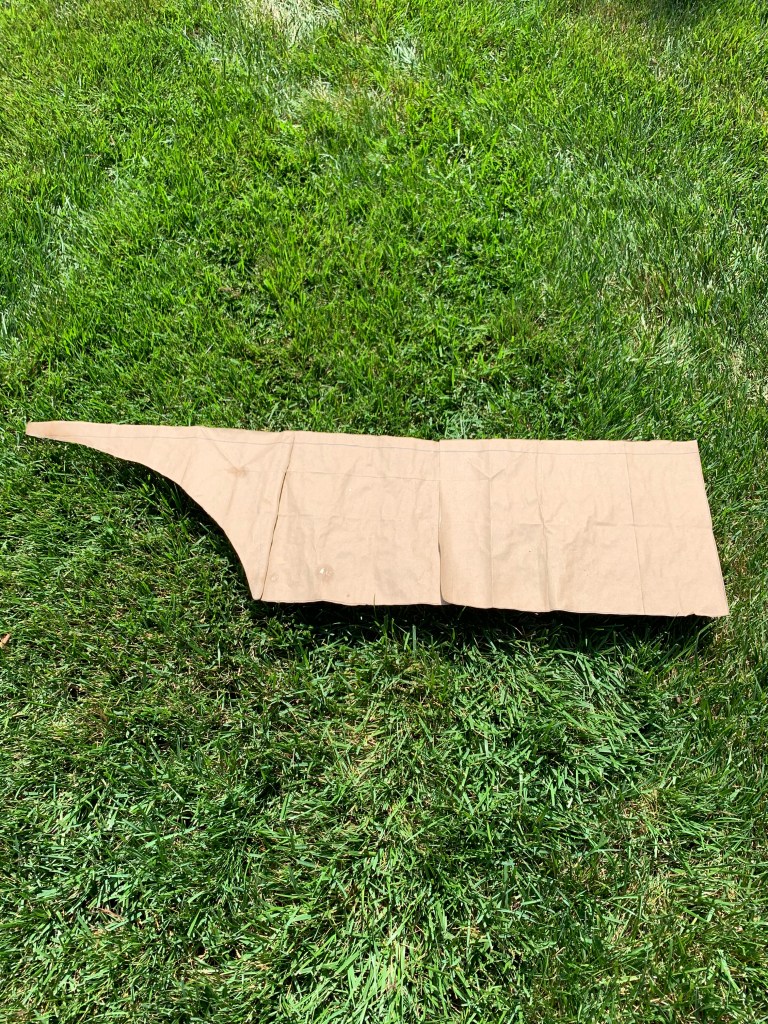
 Just remember to keep whatever you use to help yourself make the cuts, because you’ll need to make them again when you get to the siding. One decision you will have to make in this process is whether you want to use ZIPsystem plywood or normal plywood and house wrap. Personally, I had no interest in dealing with house wrap and was assured by a good friend who works as a general contractor that ZIPsystem worked just as well, and so far I’ve had no issues with it, so that’s what I would recommend. However, house wrap is definitely the go-to for a lot of people and a very safe and reliable choice. 

(If you frame your roof before sheathing, then your house will also have roof beams. However, I framed and sheathed my walls before constructing my roof)

After sheathing your house, you’ll need to go over all the seams with heavy duty, weatherproof construction tape, and you’ll need to lay down three beads of latex construction adhesive on the wheel wells. Unless you’re a wizard, there are going to be gaps between your wheel wells and the sheathing, so you’ll need to make sure the first bead completely fills up the gap and seals the bottom of the sheathing to the wheel wells to make it waterproof. The next two beads will be done behind the first bead on the inside of the house to act as secondary barriers in case water finds its way through the first bead of adhesive.

Now it’s time to move to the roof. Just like the walls, you’ll start with metal fasteners, but this time, instead of one giant band, you’ll put one strip over every peak to lock all of the roof framing in place.
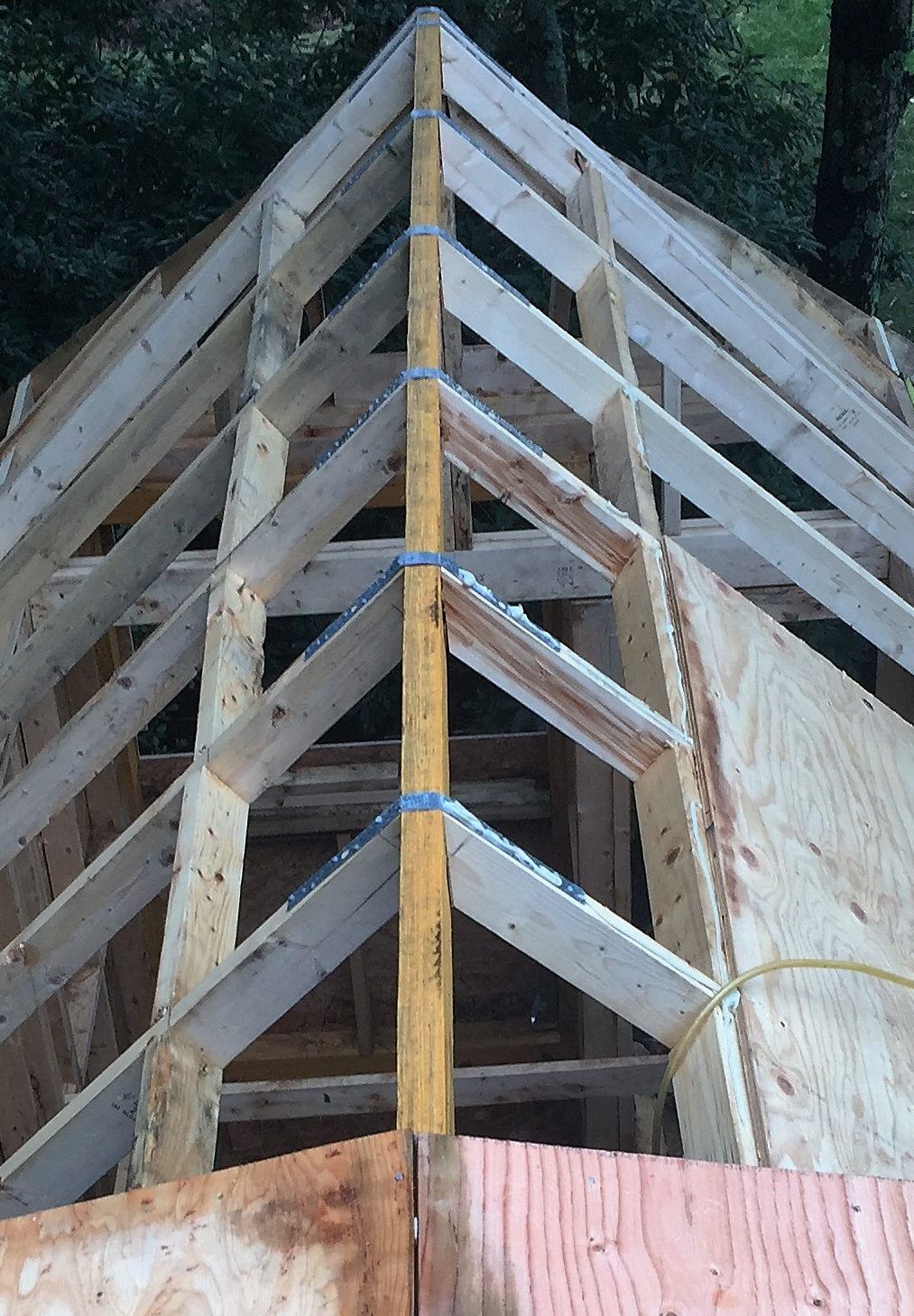
Once all the fasteners are in place, you can start sheathing the roof. I used normal plywood for the roof, because you’re going to need to install an ice and water shield over all your roof sheathing. Ice and water shields can be a huge pain to install because of how sticky it is, however, it heats up and gets its stickiest when it’s in the sun, so a good installation tip is to wait for a cloudy day (NOT a rainy day) and install it then. It’ll be sticky enough to stay on the roof but not so sticky it becomes painful to deal with. Then, once the sun comes out, it’ll heat up and fully attach to your roof.
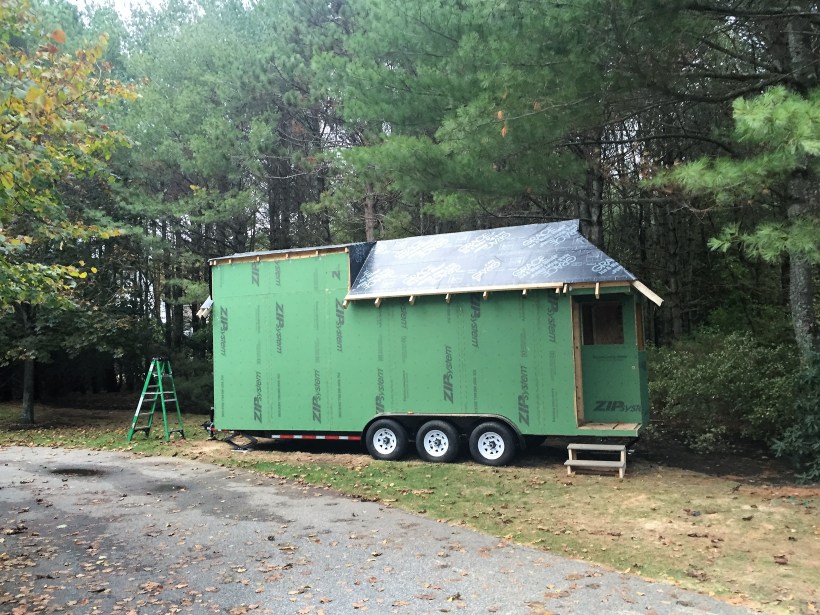
Well that’s about it. You’ve sheathed and weatherproofed your tiny house. It may not be luxurious, but hey, it’s habitable! It’s off the ground and safe from the elements, and so far, you’re turning out to be a pretty good carpenter.

That’s it for me, today.  Hopefully, you learned something new or at least enjoyed the journey. Have a great day!  And remember, if you decide to build a tiny house and only make it this far,

you can tell your kids it’s an on-the-ground treehouse and stick a wifi router out there, you might actually get some peace and quiet in your real house! Or stick your mother-in-law out there when she tries to visit and say it’s the guest house!

Disclaimer: I am not a certified contractor. All information and advice result from personal experience and should not be taken as professional guidance or used as step by step instructions on how to build a house. This is simply an attempt to give insight into the decision making process and to share my own journey building a tiny house. Not all information may be accurate to your situation, and personal research is encouraged before making any decisions.
Frame of Mind

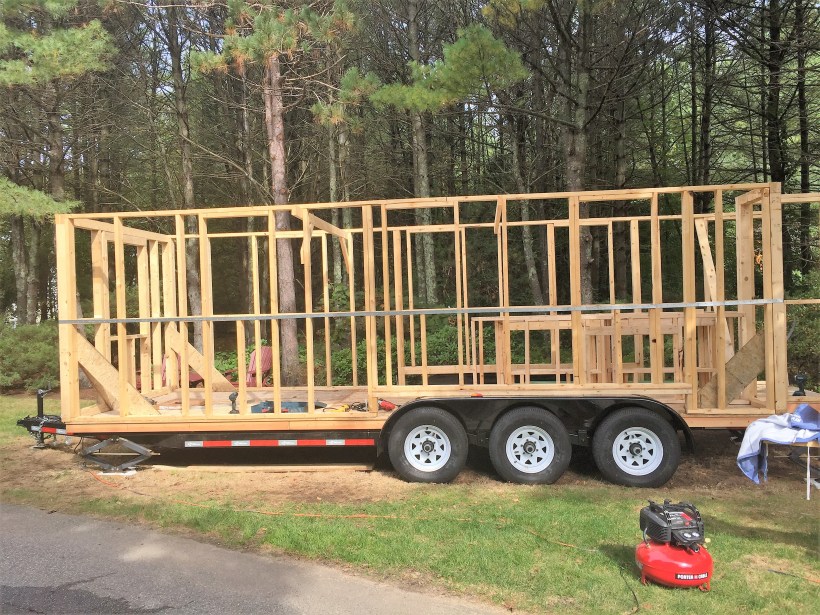
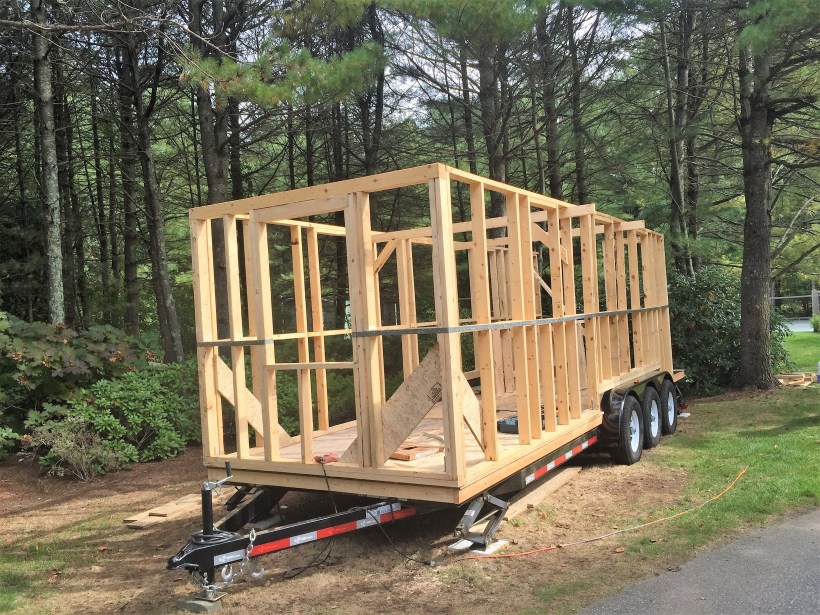
So, you’ve gotten your trailer, installed a subfloor, and are fully committed to your tiny house dreams. By now, you should also have blueprints, or at least a well thought out plan regarding how you want your tiny house to look. But maybe you’re ambitious, with a touch of crazy, and said, “what the heck, I can build a subfloor without instructions”, and you still don’t know what design you’re going for with your tiny house. Now is the time to figure that out, because the frame will determine the layout of the house such as; Where are your windows going to be? Do you want a loft? Do you want dormers? And what is the best placement for your front door?

Let’s start by looking at some different tiny house plans and what you might want to consider in your design. A loft will give you a great place to put your bed and, I strongly recommend one. However, keep in mind that the roof will be really low in a loft, so if you’re super tall you might want to reconsider as not only will it be difficult to sit up and move around, but you may also not be able to stand up underneath the loft, which would make half your house extremely annoying to traverse through and potentially lead to some serious neck and back pain down the road. 

The next thing to look at is the number and placement of your windows. The tiny house plans I used (which I bought from the Tumbleweed tiny house company: Cypress tiny house plans) had me frame positions for up to FIFTEEN windows, and I’m using fourteen of them. Tiny houses are small and can get rather stuffy, so natural light and the ability to open up the entire house are things I think are really important but it’s all personal preference. Another thing to remember is that most windows come in specific sizes, so planning ahead and making window frames to fit the windows instead of trying to find windows that fit your frames can save you a lot of headaches. If it’s too late for that, then you can always shim the windows with a little elbow grease. (Extra tip: If you can’t find windows that fit your frames remember that it’s easier and safer to make the window frames smaller than it is to make them bigger. Trying to make them bigger could compromise the structural integrity of your building well making them smaller just requires some extra wood being nailed into the frame).

Dormers are your next decision. I went for dormers and have no regrets, besides the extra cost you’ll incur on the dormer windows I really don’t see a downside, though if you decide against a loft then dormers may not make sense. So basically, if you have the money and you’re going for a loft then I suggest dormers, if you’ve decided against a loft then dormers may not be worth the extra money and you could go with skylights if you want extra light instead of the extra framing and windows required for dormers.

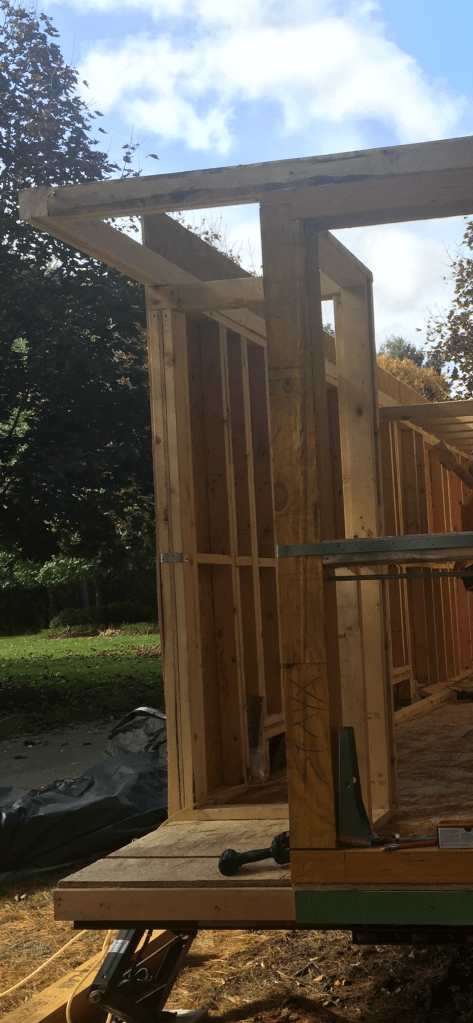
The last big framing decision to think about is where you want your door, I put mine indented into the back of the trailer.

This is a nice style because it gives you a small porch that gives the house character and allows for a spot to close your umbrella or take off your shoes before entering your house, it also gives you a great spot for window seat or table in the area inside beside the door. This door placement does, however, cut into the inside space of your house so some people put their doors on the side of the house with no indent to save space on the inside and give themselves the full backwall to put stuff on, well other people go the opposite direction and put a porch spanning the entire back wall and center the door. 

Now that you know how you want to frame your house, it’s time to finally roll up your sleeves and start building. Framing is kind of like piecing together a jigsaw puzzle, you build one wall at a time, on the ground, by laying all the wood down in the shape of the wall and then nailing it all together. Be sure to add temporary supports until all the walls are in place and the house is sealed up and stable as a stand-alone structure. The great part about building the frames is that, it can be built in pieces they can be made in your garage, near power outlets and out of the weather, before attaching them together outside. 

You’ll definitely want to recruit a friend or two to help you lift and hold the frames in place.

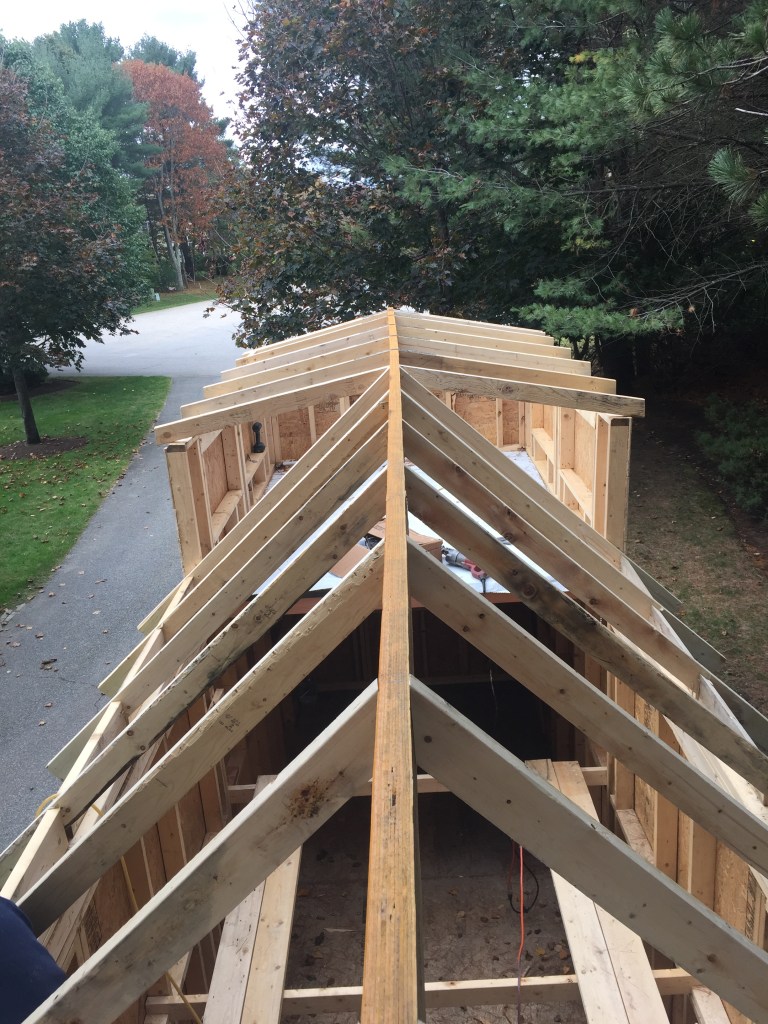
At this point you’re doing great! you should be getting a handle on using your power tools, and you already have a structure that resembles a house, but the next part of your framing journey is going to seriously test your skills: it’s time to frame your roof. You need to make a final decision on dormers and a loft, and if you have friend with easily portable scaffolding now is the time to send them a fruit basket. While it is possible to frame the roof without scaffolding (I framed mine working on maybe 2 inches of wood scaffolding I nailed onto the outside of the framework and some makeshift scaffolding I built on the inside of the house) having it makes things a lot easier. 

Putting the long center roof beam in place is rather difficult, and I again suggest recruiting, some help. You’re also going to need to make some pretty difficult cuts on the roof beams, so if you know anyone who’s experienced with power saws, they might end up saving you a lot of wood. You want to remember to build your loft beams and flooring so that it looks the way you want it to look at the end of the build as what you put in place now won’t be covered up later and it would be a pain to change. This also means you need to cover up the loft with a tarp and try not to scratch it while you’re working on it. 

By the end of the framing process, you’ll have the skeleton of your house, be much more comfortable with your tools and being on the worksite, and be able to see your dream house taking shape. At this point you can actually tell people you’re building a house, which is kind of super cool! 

That’s it for me today.  Hopefully, you learned something new or at least enjoyed the journey. Have a great day!  And remember, if you decide to build a tiny house and only make it this far, you can throw a tarp over the top and use it as a cabana!

Disclaimer: I am not a certified contractor. All information and advice result from personal experience and should not be taken as professional guidance or used as step by step instructions on how to build a house. This is simply an attempt to give insight into the decision making process and to share my own journey building a tiny house. Not all information may be accurate to your situation, and personal research is encouraged before making any decisions.